Expert analysis, industry trends, and statistical insights on automation in banking, telecommunications, and SME risk management

Romania records the highest SME credit rejection rate in the European Union, yet 8 in 10 small firms never apply. The real bottleneck is not risk — it is the rigid accounting lens of traditional banking. Alternative-data automation is changing the equation.
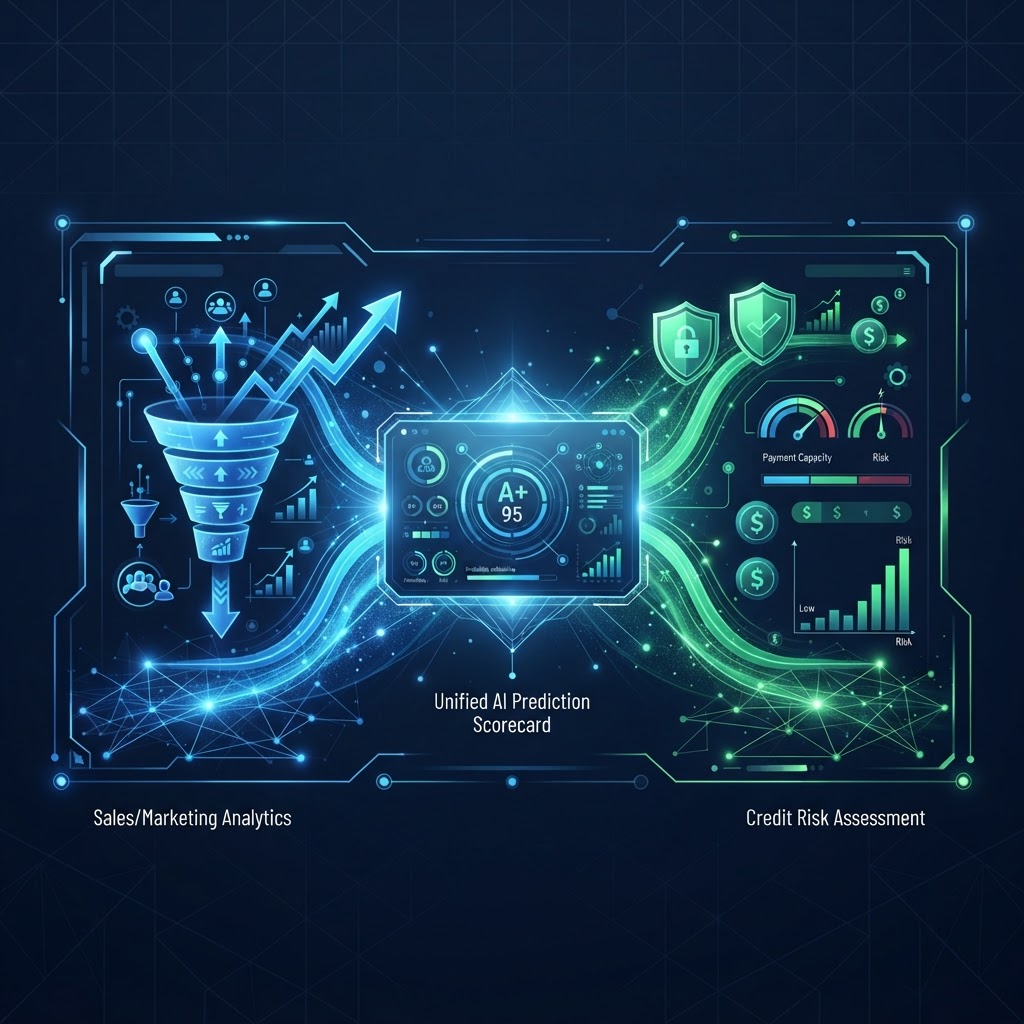
The convergence of predictive marketing and credit risk management: why leading B2B organisations in the EU and US are correlating purchase likelihood with payment capacity — and how VT Risk AI/ML algorithms operationalise this dual-score approach to protect revenue and eliminate wasted sales investment.
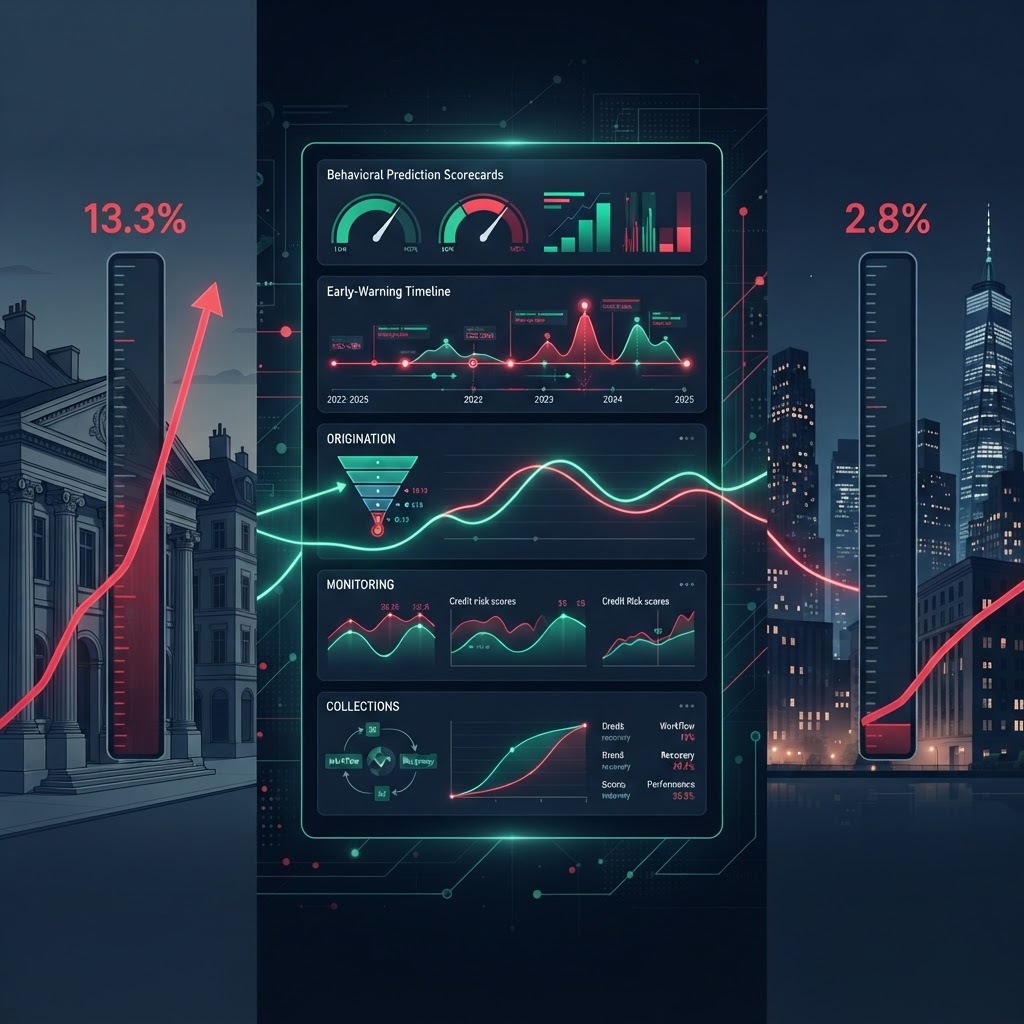
Two very different markets are flashing the same warning. Romania's state-guaranteed corporate NPL ratio has doubled to 13.3% in twelve months, while America's largest private-credit vehicles report non-accrual levels not seen since 2017. Both failures share one root cause — detection that arrives after the loss is already priced in. Here is how behavioural prediction moves the signal upstream, and why UX and data consistency decide whether the score changes the action.
Opening the top of the funnel to non-traditional clients creates an immense operational bottleneck if compliance checks remain manual. Advanced data-cleansing pipelines, automation tools, and explainable machine learning modules shift the security hurdle from upfront exclusion to persistent, dynamic profiling — allowing banks to serve the unbanked without lowering their guard.
The 1994 Nobel Prize in Economic Sciences was awarded to John Nash, John Harsanyi, and Reinhard Selten for their analysis of equilibria in non-cooperative games. The relevance to a bank, a telco, or a credit institution is direct: every portfolio is a game in which customers act strategically. This article maps the theory onto payment-behaviour, churn, and acquisition forecasting — and explains why these forecasts have moved from the analytics department into the design of operations themselves.
Paul Oyer's economics-of-sport research at Stanford GSB shows how elite athletes intuitively apply game theory without ever opening a textbook. The parallel for enterprise leaders is precise: AI can encode advanced economic theory into complex business operations, but the deciding factor is the expertise of the implementation team — not the algorithm alone.
An analysis of macroeconomic crisis signals across Romania, the EU, and the US, compared with the signals and opinions that dominated 2009. Beyond cyclical turbulence, the decisive value is built in preparation for the end of the crisis — the moment from which surviving firms construct their competitive position.
The essential distinction between regulated Operational AI and AI coding assistants, in the context of the EU AI Act and US SR 11-7 / NIST AI RMF. How VT Risk models produce measurable results from the first month of production.
Regulatory expectations in collections have never been higher. But for most institutions, the real problem isn't compliance intent — it's the systems they're running on. Here's how to tell if your infrastructure is the bottleneck.
The global risk analytics market is growing from $32.25 billion in 2025 to $51.34 billion by 2030. Discover how real-time monitoring, machine learning credit scoring, and advanced mitigation strategies are transforming how European and US financial institutions manage credit, operational, and market risk — and how to implement them.
With 71% of consumers under chronic financial stress and AI-driven debt collection market growing at 15% CAGR through 2029, behavioral science and predictive modeling are no longer optional — they are the competitive edge. Discover how leading banks and telecoms are transforming recovery rates by up to 133% using data-driven behavioral intelligence.
Leading financial institutions in the US and Europe are deploying AI/ML to transform debt collection from a cost center into a competitive advantage. The results are staggering — and the gap between early adopters and laggards is widening fast.
While regulators update the rulebook, leading financial institutions are using machine learning to build risk frameworks that don't just comply — they outcompete. Here's what the frontier looks like, and why the gap between AI-driven and traditional risk functions is becoming existential.
By the time a customer cancels, you've already lost them. The most sophisticated organizations in the US and Europe are using behavioral AI to identify at-risk customers 45 days before they make the decision — and intervening with surgical precision.
SME lending has historically been the most expensive, highest-risk segment in commercial banking. Machine learning is fundamentally changing that equation — opening a massive market that traditional credit models systematically excluded.
BlackRock's CEO declared that market leaders have always shifted with technological progress, and that companies owning data, infrastructure, and capital to deploy AI at scale will benefit disproportionately. What does this mean for financial services — and how can institutions position themselves today?
Learn how advanced behavioral segmentation transforms debt collection from generic outreach to precision-targeted strategies, improving recovery rates while preserving customer relationships.
Discover how machine learning and behavioral science are transforming debt collection from aggressive tactics to empathetic, data-driven strategies that increase recovery rates by up to 20%.
A comprehensive analysis of how American and European financial institutions approach risk management differently through data-driven strategies, regulatory frameworks, and cultural attitudes toward innovation.
Detailed analysis of process automation implementation outcomes across American and European financial institutions, with concrete ROI metrics and lessons learned from 50+ deployments.
Exploring how advanced analytics and AI are enabling financial institutions to dynamically adjust risk appetite, optimize credit policies, and balance growth with prudent lending in an uncertain economic environment.
Comprehensive analysis of how automated risk assessment is revolutionizing credit access for small and medium enterprises across European and American markets, backed by statistical evidence.
Deep dive into how leading banks and credit institutions are leveraging data-driven automation to achieve unprecedented efficiency gains and ROI improvements while offering better credit solutions to SMEs.
How leading telecommunications companies are leveraging data-driven automation to predict and prevent customer churn, optimize pricing strategies, and enhance customer lifetime value.
Exploring how real-time data processing and automated risk assessment are enabling financial institutions to make faster, more accurate decisions while reducing exposure to bad debt and fraud.
Get the latest insights on data-driven automation and risk management delivered to your inbox
We respect your privacy. Unsubscribe at any time.